Schattenvald – Interview with Nachtsturm (english) june 2026
Share it
Since 1998, Schattenvald has remained one of the most faithful entities to the primitive spirit of German black metal. Their raw, forest‑driven sound has evolved without losing the essence that defined their early demos in the early 2000s. With Alle Hernach, released through the historic Solistitium Records, the band revisits its own past, reinterprets old material and reaffirms an identity that has never relied on external trends.
We speak with Nachtsturm, the musician and creative core behind the project, whose vision has kept Schattenvald on its own path for more than two decades.
Share it
INTERVIEW WITH NACHTSTURM (SCHATTENVALD)
Since 1998, Schattenvald has remained one of the most faithful entities to the primitive spirit of German black metal. Their raw, forest‑driven sound has evolved without losing the essence that defined their early demos in the early 2000s. With Alle Hernach, released through the historic Solistitium Records, the band revisits its own past, reinterprets old material and reaffirms an identity that has never relied on external trends. We speak with Nachtsturm, the musician and creative core behind the project, whose vision has kept Schattenvald on its own path for more than two decades. In this interview we explore the origins, the relationship with the label, the creative process and the project’s future direction.
1.- Schattenvald was founded in 1998, but the first demo didn’t appear until 2002 and the first official album wasn’t released until 2007. Nearly ten years passed between the origin of the project and the full‑length debut. What was the main reason behind this long process? Did your involvement in Cryptic Wintermoon at the time play a role in it?
Hey Jose! Well, between 1998 and 2005, I was really just collecting songs for myself—without any clear ambition to ever release the material on a larger scale. It was fun experimenting with 4-track recorders; the whole thing was really just one big experiment. After all, I was still going through puberty around the turn of the millennium—for heaven’s sake! Haha… Cryptic Wintermoon commanded my full attention, and I also had another band called Angelus Mortis, which leaned more toward thrash. The whole Schattenvald project grew more or less on the side—very slowly—and was actually far too intimate for me to want to release it publicly. Eventually, though, I realized that there was actually something more to it… So, starting in 2006, I began releasing demos as burned CDs—100 copies at a time. They were numbered I through III (though it’s not actually a trilogy, as many people seem to believe). After that, I lost interest for a while, until my old buddy Iskharian came along in 2011 and breathed some fresh life into the project. From that point on, we were a duo.
2.- Your latest album, Alle Hernach, was released through Solistitium, a historic label that once worked with bands such as Helheim, Isvind, Wyrd and even early Behemoth. How did you first get in touch with Carsten, and how did this collaboration begin? What is your current relationship with the label?
The connection was established through Florian Dammasch—the same person I recorded with at Nightside Audio Studio. Carsten was on the lookout for new bands because he wanted to revive his cult label. It was likely just a coincidence that Schattenvald ended up on his radar. Carsten does some damn solid work; the man truly knows his craft, and he’s a genuinely stand-up guy. He simply works with bands that resonate with him personally, refusing to bow to the prevailing zeitgeist. On top of that, he holds an incredibly demanding full-time job—I honestly don’t know how he manages to juggle it all. He’s just an absolute beast…
3.- The old songs were re‑recorded for Alle Hernach instead of being reissued in their original form. What was the real reason behind that decision? Which aspects of the early material did you find insufficient or problematic enough to justify a complete reinterpretation?
The idea was to reissue older albums on vinyl as well. However, I hadn’t listened to this material in a long time, as I had come to find the sound too extreme over the years. It simply bothered me to release it in its original form on such a high-quality medium as vinyl—especially since I felt the material was incomplete and possessed real potential. So, I decided to record it properly this time around, with professional assistance. Looking at the result, it was more than worth it. I didn’t want this to be some half-assed re-recording job—like that *Stormblast* catastrophe by Dimmu Borgir in 2005, which completely destroyed the original atmosphere. I truly wanted to capture all the mood and spirit from over twenty years ago; consequently, I made a point of using only vintage equipment to ensure the result felt authentic.
4.- Alle Hernach is inspired by the visions of Mühlhiasl, an almost mythical figure in Bavarian folklore. What drew you to his story, and how does his apocalyptic outlook connect with Schattenvald’s musical identity?
This is a story that, in this part of the world, you essentially pick up on as a child. It is simply embedded in the collective memory of the people here. After all, people everywhere have their own local legends—for instance, the *Schimmelreiter* in Northern Germany, or various ghostly «White Ladies,» and the like. The connection to the Mühlhiasl had actually already emerged in the older songs, albeit in a completely jumbled and unstructured way, since back then I hadn’t really started paying much attention to lyrics yet. But when, while contemplating the re-recording, I turned my thoughts to the subject of lyrics, the idea struck me to tell this as a cohesive, continuous story—and, as it happened, the existing lyrical fragments actually fit into that framework quite nicely. The rest involved a bit of research and—I admit it—a touch of invention…
5.- Schattenvald’s sound has always maintained a raw, cold aesthetic strongly tied to the Central European black metal of the 90s. Which elements do you consider essential to preserve that identity, and which ones have you allowed to evolve over time? Are there any bands that have influenced you significantly, either in the early years or in the current stage?
Naturally, I won’t give away too many secrets, but the equipment really is the key. I don’t use modern, pre-packaged sounds; instead, we craft them ourselves using transistor amplifiers, mixers, amps, and cabinets. Since the older material was always recorded using an electronic drum machine, we used a real acoustic drum kit this time around—something I actually had to learn how to play first, as it works completely differently than a cheap electronic kit. I’ve been influenced by countless bands: Limbonic Art, Emperor, early Ulver, the first Manes album, and so on. My collection consists of 3,000 CDs; by now, I even have a dedicated music room just for my CDs and records… I suppose I’m just very old-school in that regard—it’s something I simply can’t shake.
6.- The sound of Alle Hernach stands out for preserving the rawness of classic black metal while achieving a very current level of clarity and presence. Where was the album recorded, and what was the experience like revisiting and re‑recording these songs after so many years?
It was recorded at the other end of Germany—in Solingen, at Nightside Audio Studio. Here, I can simply do whatever the hell I want without an annoyed sound engineer laughing at my hopelessly outdated gear… Florian Dammasch is truly up for anything—no matter how crazy—without ever making fun of me. Re-recording the material was actually quite an interesting look back at my own history, since you don’t exactly get to experience something that intense every day. You realize what you were doing back then, and just how different it is from today. I’d also like to redo *Werke II* and *III*, but that’s going to be really tough from a performance standpoint—after all, I haven’t played those songs since back then, so I’ll have to teach them to myself all over again first
7.- Schattenvald has always operated with a very personal and self‑sufficient vision. What is your creative process like today? Is it still an immediate impulse that you develop when an idea appears, or do you now work with a more defined structure when shaping a new album?
Yes, exactly like that. It’s the same as always—I simply couldn’t compose or record any other way. I honestly wouldn’t even know how to go about it… I can only do it alone; other musicians just end up messing everything up for me. The other members only join in once the songs are essentially finished, and then they record their parts. I feel that the principle of democracy doesn’t work in music—otherwise, everything just turns into watered-down, compromised nonsense. I hate it when everyone sticks their nose in and dilutes the style into a shapeless mush. That would extinguish my fire on the spot.
8.- The cover artwork of Alle Hernach preserves that dark, forest‑driven aesthetic so characteristic of Schattenvald. Who is the author of this piece, and what were you aiming to express visually in relation to the album’s concept?
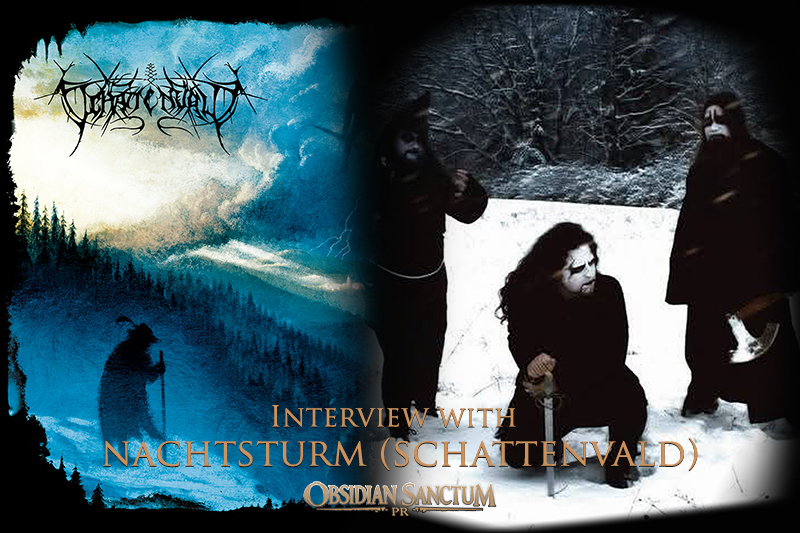
The image is by Sperber Illustrationen. It depicts Mühlhiasl sitting alone in the forest—typically in specific, significant spots—discerning grim visions within the clouds. In the distance, a monastery can be seen, upon which the last warm ray of light falls—surrounded by a world so icy cold that merely gazing upon it feels enough to give one pneumonia. For this monastery, too—and for God’s flock—the time of comfort is soon to end; for, within the historical context of the era, the Church was at that time being dispossessed of its assets (as mandated by the *Reichsdeputationshauptschluss* of 1803).
9.- Schattenvald has always been a very isolated project, detached from trends and movements within the scene. Is that isolation an aesthetic decision, a personal necessity, or simply the natural way the project functions?
I’m simply not a very sociable person—and certainly not deeply rooted in the scene. I know a handful of great people, and that’s enough for me. That’s probably why I’ve never really built up a huge following. But now we’ve decided to take this project to the stage as a full band, so I’m really curious to see how it turns out.
10.- After revisiting old material, reinterpreting it and releasing Alle Hernach, where do you feel Schattenvald stands now? In which direction would you like to take the project in the coming years?
Of course, Schattenvald was never as well-known as it is today—something that is, naturally, also thanks to Solistitium Records. Naturally, I want to continue recording albums—both old material and new. And as for the live band, I’ve already mentioned that. Up until now, the stumbling block has always been finding suitable bandmates; since there isn’t much of a scene in this area, some of them have to travel quite a long way to get here. But perhaps, one day, we’ll even make it onto an international stage or two. Time will tell what happens. In any case, even after nearly 30 years of Schattenvald, I certainly haven’t lost my drive..
Thank you, Nachtsturm, for taking the time to share your thoughts and experiences. Your perspective adds real depth to this interview, and it’s been a pleasure exploring the world of Schattenvald through your words. Wishing you strength and success in everything that lies ahead.
Obsidian Sanctum PR is a promotional agency dedicated to extreme Metal in all its forms. We publish news, reviews, and interviews, and offer three specialized promotional packages: Ashes, Obsidian, and Sanctum — tailored to elevate your band’s visibility across media and audiences.